|
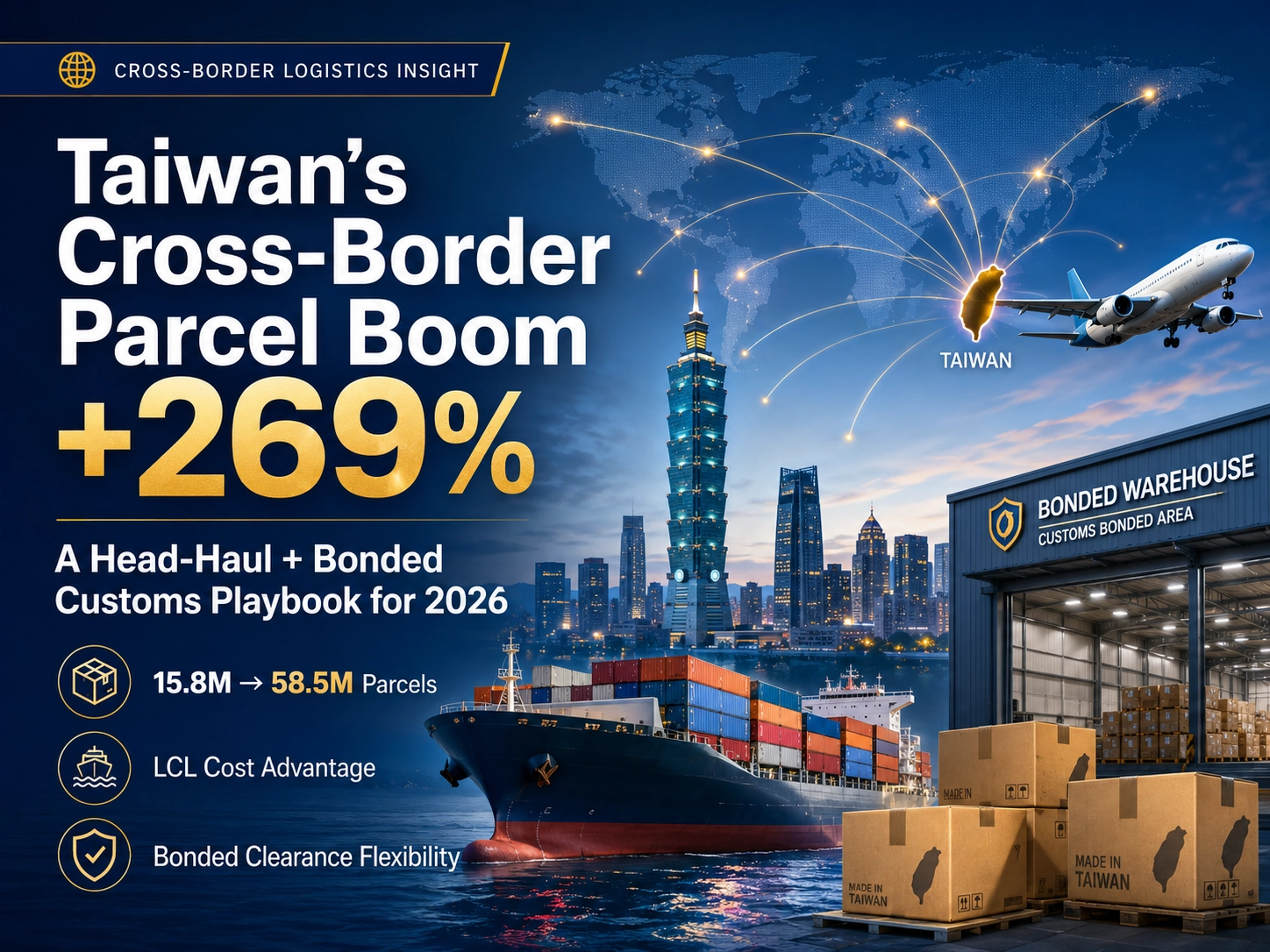
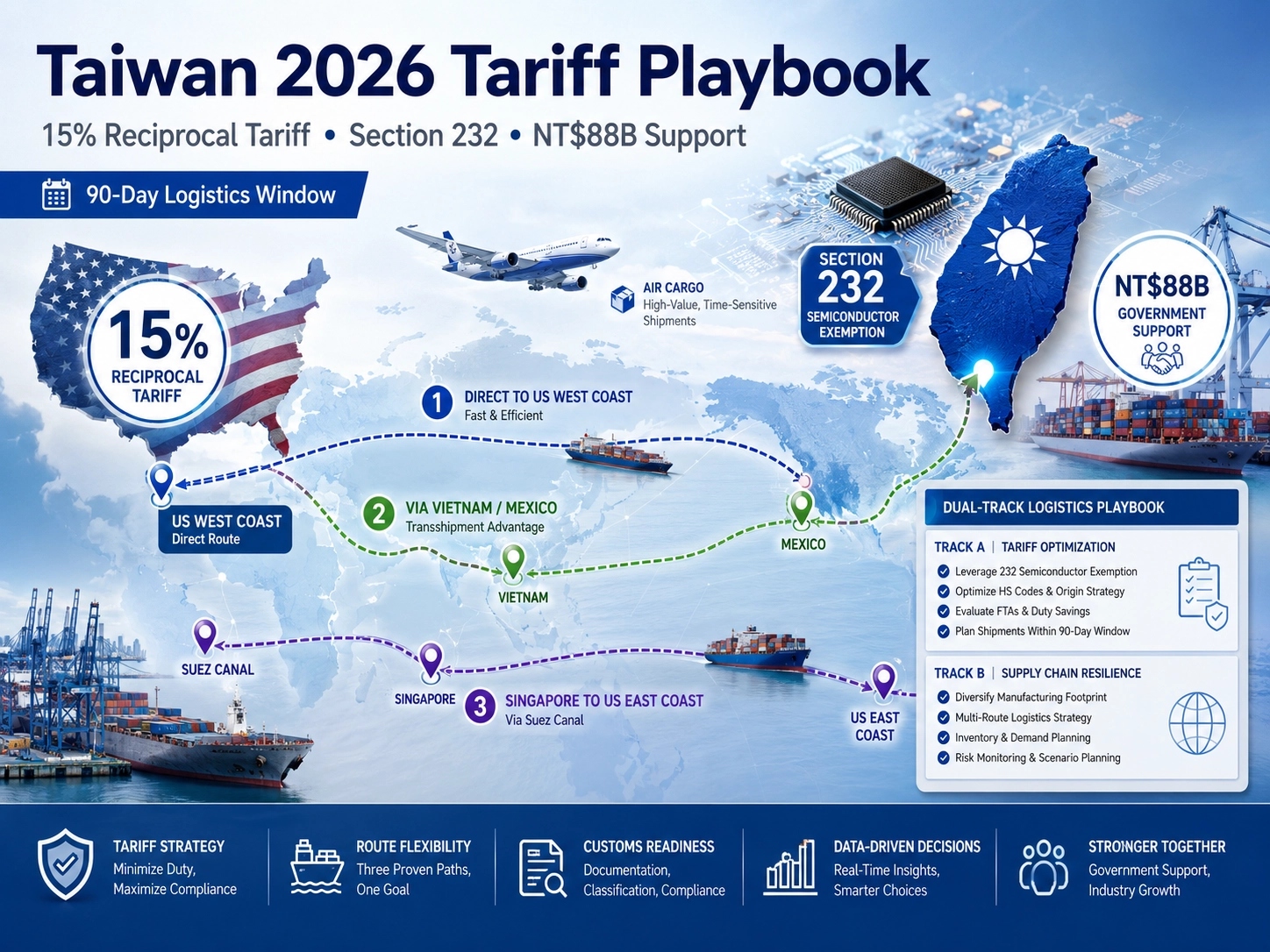
Trade Policy Insight · May 2026 Taiwan's 15% Reciprocal Tariff in 2026: A Dual-Track Logistics Playbook on Section 232 and the NT$88B Support PackageTrump 2.0's 15% tariff cap, Section 232 semiconductor exemptions, and Taiwan's NT$88B support package open a 90-day window for shippers to rewire routes and lock capacity. 📅 Published May 6, 2026 · ⏱ 7 min read · 🏷 Tariff · Section 232 · NT$88B |
|
TL;DR for Procurement & Logistics Heads The Taiwan–US deal caps reciprocal tariffs at 15%, with a Section 232 carve-out that lets fab builders ship semiconductors duty-free at 2.5× capacity during construction. Taiwan's NT$88B package adds credit guarantees, port-fee relief, and market-diversification grants on top. The window for realigning lanes, slots, and origin paperwork closes at end of Q2 2026 — whoever finishes first owns the Q3 peak. |
1. From 32% to 15%: The 2026 Tariff Map
On January 15, 2026, Taiwan and the US closed a reciprocal trade deal capping Taiwanese imports at 15%, non-stacking with MFN duties. After the Supreme Court struck down the IEEPA tariff regime in February 2026, the rate was rebased under Section 122 at 10%, with a July 24 sunset. Taiwan committed at least US$500B of investment in the US — half direct, half credit-backed — anchored on semiconductors, AI, and energy.
For Taiwan's export-logistics sector, this is not "tariffs are lower, party on." It is a three-axis structural window: rate adjustment × investment commitment × industry rerouting. Whoever realigns lanes, slots, and customs paperwork before Q2 closes will win the Q3 peak-season inquiry surge.
|
15% Reciprocal tariff cap, non-stacking with MFN |
US$500B Taiwan investment commitment to the US |
Jul 24 Section 122 rebase sunset date |
| The 90-day window: The Section 122 sunset and the Q3 peak season collide in late July. Lane, slot, and origin paperwork decisions made now compound through year-end. |
|
Quick Answer When does the 15% cap take effect? January 15, 2026; rebased under Section 122 in February; sunsets approximately July 24, 2026. |
2. Section 232 Logistics Bonus
Section 232 levies 25% on specified semiconductors from Jan 15, 2026. The under-discussed logistics gift inside the deal: Taiwanese firms building US fabs may import semiconductors duty-free at 2.5× their new capacity during construction, and 1.5× post-completion.
| Stage | Duty-free Multiplier | Logistics Implication |
|---|---|---|
| Construction | 2.5× | Burst-mode shipping; lock east-coast express slots |
| Post-launch | 1.5× | Structural long-term volume; annual contract candidate |
For Mingsung clients, quota = slot leverage. We recommend a Quota-to-Slot Match Sheet aligned to USMCA paperwork and B/L records.
|
Quick Answer How do I use the Section 232 bonus? 2.5× duty-free during US fab construction, 1.5× after. Needs USMCA paperwork plus B/L tie-out. |
3. NT$88B Package: What Shippers Actually Use
Taiwan's Executive Yuan announced an NT$88B, 9-pillar / 20-measure package. Four lines matter for shippers:
|
Line 1 — Credit Guarantee Plus a 1.5% interest subsidy on qualifying loans. |
Line 2 — Customs & Port-fee Relief Direct cost relief at the port and customs interface. |
|
Line 3 — Market-Diversification Grants Up to NT$500K per case for New Southbound, India, Middle East. |
Line 4 — R&D Tax Credit Expansion Extends qualifying scope for export-engaged manufacturers. |
Most SMEs only tap line 1. Mingsung's playbook is to bundle line 3 with Southeast-Asia transshipment in Q2 to compress duty + freight + concentration risk simultaneously.
|
Quick Answer Which NT$88B lines apply to logistics? Credit guarantee, port-fee relief, market diversification, and R&D credit. Lines 1–4 directly address logistics cost, capacity, and origin-restructuring needs. |
4. Lane Reroute: Three Practical Paths
USTR launched a Section 301 "structural overcapacity" probe in March 2026, naming China, the EU, and Taiwan among others. The 15% cap is provisional; origin determination is the next audit front.
|
Direct USWC High-value low-weight cargo — electronics, semiconductors. Speed and origin clarity matter more than per-TEU rate. |
Vietnam / Mexico Transshipment Machinery, bicycles, traditional parts — re-qualifies under different origin rules. Most exposed to a Section 301 audit. |
USEC via Suez CMA CGM resumed India–USEC Suez service Jan 2026. Taiwan freight via Singapore connect can shave 8–12%. |
|
Quick Answer Will US lanes change? Yes. CMA CGM and Maersk are resuming Suez. Run a direct + transshipment dual-track rather than picking one. |
5. SME 90-Day Plan
The realignment work breaks cleanly into three phases. Each one feeds the next; skipping ahead loses leverage at the contract-signing stage.
|
Phase 1 Day 1–14 HS Code × US-buyer matrix. Build the Section 232 / 301 applicability map. |
Phase 2 Day 15–45 Apply for the NT$88B package. Evaluate transshipment lanes. Secure credit-guarantee envelope and origin certificates. |
Phase 3 Day 46–90 Sign Q3 peak-season annual contracts. Lock slots. Finalize the Quota-to-Slot Match Sheet. |
|
Quick Answer When should SMEs start? Q2. Finish Q3 lock-up before peak season hits. |
6. The Real 2026 Dividend Is Logistics Flexibility
Tariffs are the swell; logistics flexibility is the keel depth. Shippers who realign customs, capacity, and grants within 90 days will pull ahead of the field by Q3. The 15% cap is the headline; the Section 232 carve-out, the NT$88B grant lines, and the Suez-via-Singapore option are the operational levers that decide who actually captures the dividend.
| Get an Instant Ocean-Freight Quote → Taiwan–US Service Line |