|
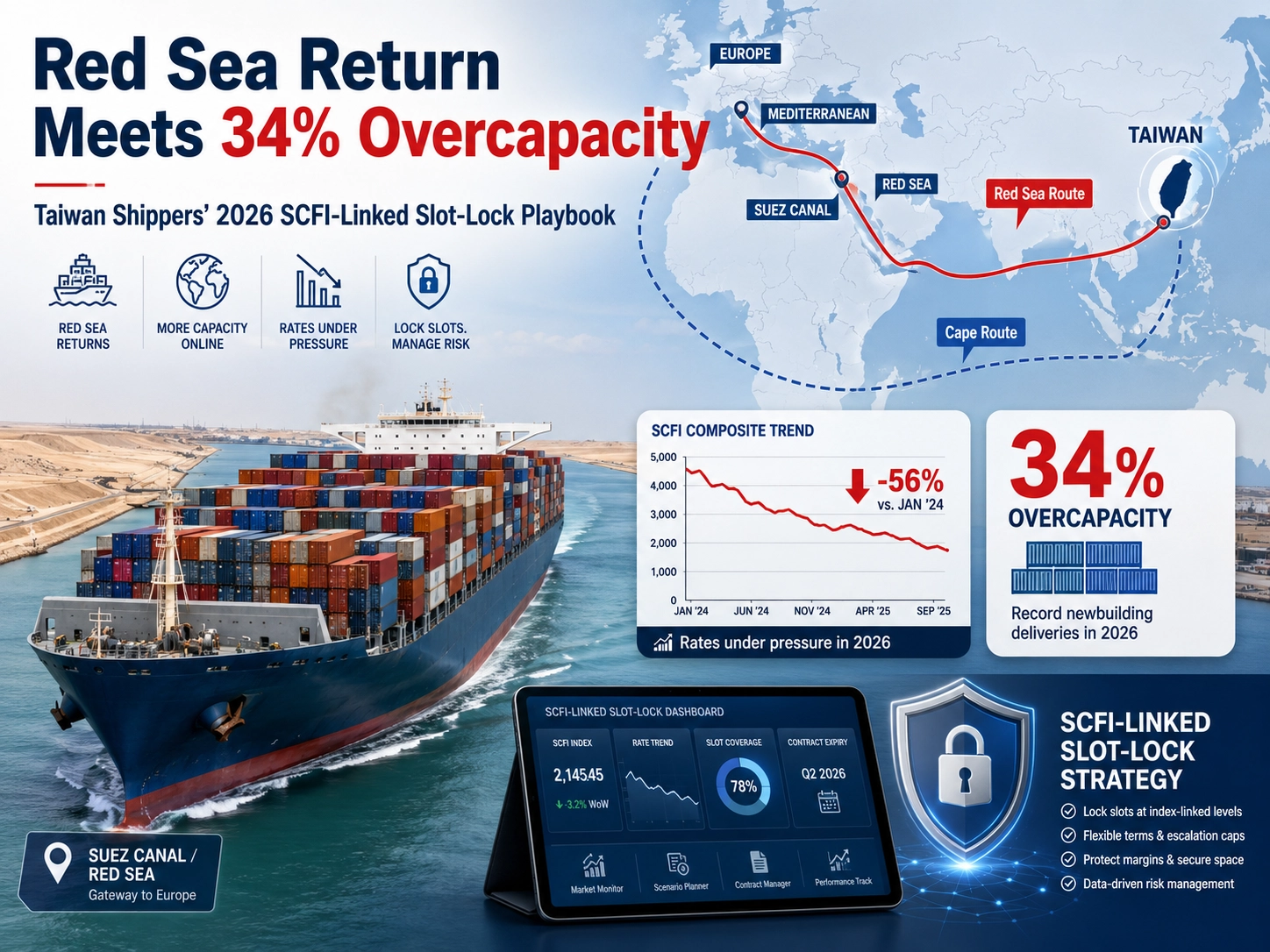
Ocean Freight Insight · May 2026 Red Sea Return Meets 34% Overcapacity: Taiwan Shippers' SCFI-Linked Slot-Lock Playbook for 2026With Red Sea traffic resuming and the orderbook at 34% of fleet, SCFI heads structurally lower in 2026. Here's how Taiwan shippers should restructure long-term contracts and slot allocations. 📅 Published May 6, 2026 · ⏱ 6 min read · 🏷 SCFI · Red Sea · Slot Allocation |
|
TL;DR for Procurement & Logistics Heads Red Sea is functionally back, 1.75M TEU of effective capacity is returning, and another 5.4M TEU sits in the orderbook against just 2.5% demand growth. The question for 2026 is no longer where rates go — it's how you allocate. Lock the wrong percentage long-term and you'll be paying wartime prices for peacetime slots. |
1. From 95% Diverted to Suez Pilot Calls
Since late 2023, roughly 95% of Asia–Europe vessels rerouted via the Cape of Good Hope. That picture changed in two steps: Maersk pushed its first Red Sea transit in two years in late December 2025, and CMA CGM resumed India–USEC Suez service in January 2026. By Q1 2026, the southern Red Sea had moved into a low-tempo, sporadic-incident state.
For Taiwan shippers, two operational realities just shifted:
|
−7 to −10 Days shaved off Asia–Europe transit |
↓ War-risk premiums begin to ease |
2024 Wartime contract structures now expiring |
| Bottom line: Holding 2024 wartime contract structures into Q3 2026 means paying war prices for peacetime slots. |
|
Quick Answer Is the Red Sea fully reopened? No. Maersk and CMA CGM are calling, but Cape of Good Hope routing remains the 2026 default with Suez as supplement. |
2. The 34% Math: 1.75M TEU About to Hit Water
Alphaliner's March 2026 read pegged the global containership orderbook at 34% of active fleet — a 17-year high. Set against demand growth of only 2.5%, the supply-demand gap is structural, not seasonal. Layer Red Sea normalization on top, and another 1.75M TEU (5–6% of fleet) of effective capacity returns to the market.
|
34% Orderbook / active fleet (17-year high) |
2.5% 2026 demand growth |
1.75M TEU of effective capacity returning |
|
Quick Answer Is 34% overcapacity measured against the fleet? Yes — orderbook-to-active-fleet ratio per Alphaliner March 2026, a 17-year high. |
3. Reading SCFI Right
The Shanghai Containerized Freight Index publishes every Friday at 15:00 Taipei time. The trap is treating each weekly tick as a signal — it isn't. The signal is two consecutive weeks in the same direction, with four weeks confirming a trend.
|
Quick Answer When does SCFI publish? Friday 15:00 Taipei time. Read it as a 2-week same-direction signal plus a 4-week confirmed trend. |
| Lane | Dec 2025 SCFI | 2026 Q2 Outlook |
|---|---|---|
| Shanghai – Europe | $1,533 / TEU | Flat to weak |
| Shanghai – Mediterranean | $2,833 / TEU | Moderate decline |
| Shanghai – USWC | ~$2,000 / FEU | Choppy weakness |
|
Mingsung's Internal Trigger Rules
|
4. Long-Term vs Spot: The 2026 Balance
Long-term rates have already adjusted. Far East–Mediterranean long-term rates fell 25% versus end-2025; Far East–North Europe fell 10%. All-in long-term locks the high; all-in spot risks no slot at peak. The right answer is structural, not directional.
| Allocation | Share | Use Case |
|---|---|---|
| Annual contract | 40–60% | Anchor customers, stable PO flow |
| 6-month contract | 20–30% | Seasonal flex |
| Spot | 20–30% | Opportunistic, dip-buying |
3 : 2 : 2 with quarterly review is the 2026 baseline. Heavier on long-term if your PO book is sticky; heavier on spot if you have flexibility on origin and ETD.
|
Quick Answer Is long-term lock-in risky in 2026? Use a three-tier split: 40–60% long-term, 20–30% mid-term, 20–30% spot, reviewed quarterly. All-in either side is what creates the risk. |
5. Mingsung's Hedging SOP
How we operate this for our Taiwan shipper clients, end to end:
|
6. The 2026 Question Is Allocation, Not Direction
The question isn't how far rates fall — it's how to avoid being the last knife-catcher. Taiwan shippers who finish the three-tier allocation by end of Q2 2026 keep pricing flexibility through Q4. Those who wait will be negotiating annuals against a still-falling curve in November.
|
Quick Answer How do SMEs access Mingsung's slot-lock service? Request a quote on our website with 3 months of shipping history. |
| Live SCFI-Linked Quote → Asia–Europe Service |