2026 Three Gorges Lock Maintenance: A Guide to Shipping Disruptions & Alternative Routing
In the Yangtze shipping market, our biggest headache isn't necessarily rising freight rates—it’s the dreaded "lock bottleneck." When the Three Gorges Lock enters its scheduled maintenance period, throughput capacity drops and vessel queues begin to stack up. For shippers, this creates a domino effect that hits delivery lead times, inventory management, and cash flow.
Taking a strategic procurement and shipping perspective, we’ve compiled everything you need to know: the 2026 maintenance window, the mechanics of these delays, and the most viable contingency routes—including Rail-Water intermodal transport and the New Western Land-Sea Corridor. Use this guide to lock in your "Plan B" before the shutdown hits.
Understanding the 2026 Three Gorges "Lock Overhaul": Official Schedule & Key Takeaways
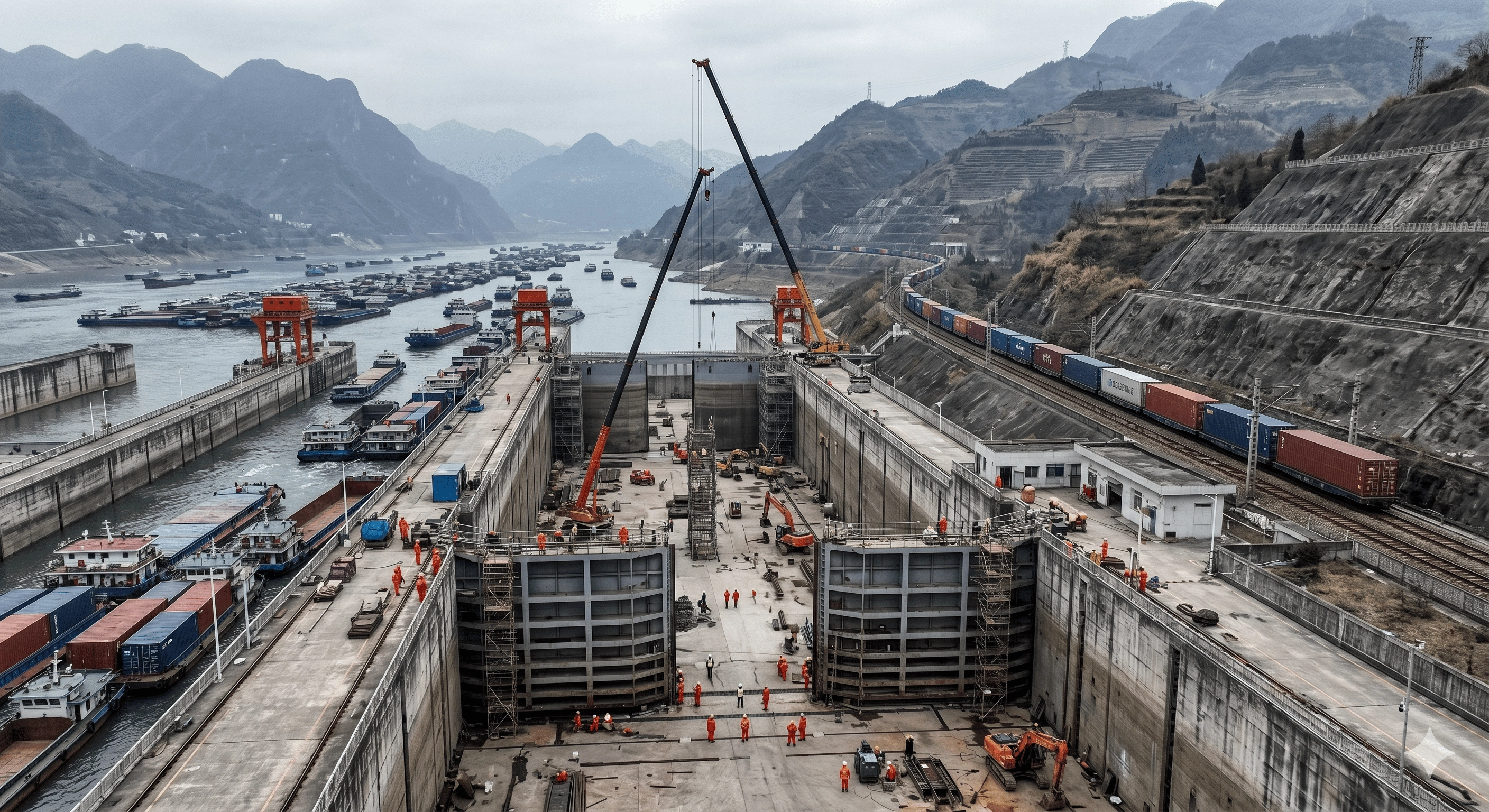
According to the Preliminary Notice issued by the Three Gorges Navigation Authority (TGNA) via the Ministry of Transport platform, the scheduled maintenance for the Three Gorges South Line Lock and the Gezhouba No. 2 Lock is set to begin at 08:00 on March 4, 2026.
- Three Gorges South Line Lock: 45-day maintenance window.
- Gezhouba No. 2 Lock: 40-day maintenance window.
A quick heads-up from the field: The official notice explicitly states that the schedule is "subject to change and further announcement." In our world, "planned" doesn't always mean "fixed"—always keep a close eye on real-time official updates as the situation on the river can shift quickly.
Why Maintenance Triggers Massive Delays: The Logistics Breakdown
1. The Shift from Dual to Single-Lane Operations During the overhaul, the North Line Lock becomes the primary artery, supported by the Gezhouba No. 1 and No. 3 Locks and the Ship Lift. This forces a single-lane alternating traffic pattern. The North Line will switch directions approximately every 48 hours, though this is subject to real-time adjustments based on the queue. For shippers, missing a "window" can mean an automatic two-day setback.
2. Volume Control & "Priority Access" (It’s Not First-Come, First-Served) The authorities will manage traffic via Daily Operational Plans and Rolling Forecasts. Crucially, lockage is granted based on cargo categorization and priority protocols (e.g., essential supplies or key commodities). Furthermore, strict congestion caps are in place; for instance, the total number of vessels waiting near the dam is typically capped at 600 units. If you aren't on the priority list, you're looking at a long wait.
3. Amplification of the Existing "Dam Bottleneck" "Dam-crossing" (fanba) is already a notorious pain point on the Yangtze. Maintenance simply exacerbates the volatility. According to historical data from transport authorities, average wait times in high-pressure "stress scenarios" have peaked at nearly 9.3 days. This isn't just a minor delay—it’s a major disruption to the entire supply chain.
The Most Viable Contingency Plans
Option A: Continued Waterway Transit (Utilizing Available Channels)
Best For: Shippers who require end-to-end water transport and whose vessels meet the specific operational criteria for the North Line Lock or the Ship Lift.
Strategic Execution:
- Secure Vessel Slots Early: Traffic spikes are most severe immediately before and after the maintenance window. You need to lock in your shipping dates and "queue nodes" well in advance to avoid being caught in the peak backlog.
- Audit Ship Lift Eligibility: The Three Gorges Ship Lift can serve as a vital "fast track" bypass, but only for vessels that meet strict size and weight requirements. Confirming your vessel’s eligibility early can save you days of waiting.
Option B: "Yangtze Express Rail" (Rail-Water Intermodal Bypass)
The most widely adopted alternative for bypassing the dam.
Best For: Bulk commodities, industrial components, and containerized cargo moving between Upstream hubs (Sichuan/Chongqing) and Mid-to-Downstream/Coastal regions. This is the go-to for shippers who prioritize lead-time reliability over rock-bottom pricing.
The Operational Logic: Instead of waiting for the lock, cargo undergoes a water-to-rail transshipment at upstream ports (such as Chongqing Guoyuan or Luzhou). The goods are railed to the Jingzhou or Wuhan area, where they are transferred back to vessel for the final leg of the journey (or vice-versa for inbound shipments).
Why it works (The Value Prop): The primary driver here isn't cost—it’s risk mitigation. The core value of the "Yangtze Express Rail" is its ability to circumnavigate the unpredictability of the lock queue. As regional authorities have noted, this intermodal corridor provides a "stable, fixed-schedule alternative" that removes the guesswork from your supply chain.
Transit Time Benchmarks (Conservative Estimates): According to regional trade reports, while the "all-water" route typically takes 15–20 days during peak congestion, the Rail-Water bypass can reduce that to approximately 10 days. (Note: Actual transit times are contingent on cargo type, terminal handling speeds, and rail departure frequencies.)
Option C: The Western Land-Sea New Corridor (Southward Diversion)
The ultimate "Exit Strategy" to bypass the Yangtze entirely.
Best For: Export cargo from Sichuan, Chongqing, and SW China bound for Southeast Asia, the Middle East, or Europe. It is the ideal solution for shippers who want to eliminate "river-locked" risks by shifting their exit point from the East Coast to the South.
The Operational Logic: Instead of the traditional "Eastward to the Sea" route via the Yangtze, cargo moves Southward by rail from inland hubs like Chongqing or Chengdu to the Beibu Gulf (e.g., Qinzhou Port). From there, it connects directly to international deep-sea vessel strings—completely bypassing the Three Gorges bottleneck.
Why it’s a "Game-Changer" for your Supply Chain:
- Premium Express Reliability: The corridor has established dedicated "Express Liners" (such as the Chongqing–Qinzhou–Haiphong route). Transit from Chongqing Tuanjiecun to Qinzhou Central Station is now down to approximately 2 days, with daily departures ensuring your cargo doesn't sit in a yard.
- Drastic Lead-Time Reduction: For a shipment from Chongqing to Singapore, this southward route is significantly faster than the traditional eastward river-to-sea path. Depending on your specific cargo and connection, you can save a massive amount of transit time by cutting out the Yangtze leg entirely.
Option D: The Hybrid Portfolio (Customized Diversion Strategy)
If your client’s freight flow is diversified—for instance, balancing domestic distribution in East China with international exports—a "one-size-fits-all" approach is a recipe for disaster. In the field, we recommend a Multi-modal Hybrid Strategy to balance cost-efficiency with supply chain resilience:
- Cost Optimization: Maintain a portion of your volume via the North Line or Ship Lift to retain the lower cost-basis of all-water transport.
- Lead-Time Protection: Shift time-sensitive or "must-arrive" domestic shipments to the Yangtze Express Rail to guarantee delivery windows.
- Export Risk Mitigation: Route international cargo through the Western Land-Sea New Corridor to eliminate the "lock queue" variable entirely from your global lead times.
The Veteran’s Take: Execution is Everything The success of a diversion strategy hinges on Proactive Planning. To avoid a last-minute scramble once the locks close, you must lock in the following four pillars at least 30–60 days in advance:
- Demand Forecasting: Accurate volume projections to avoid over or under-booking.
- Slot Allocation: Securing guaranteed space on rail lines before the peak-season surge.
- Nodal Audit: Vetting your transshipment points (container yards and warehouses) for capacity.
- Documentation Readiness: Ensuring customs and transit paperwork are synchronized for different corridors.
The Enterprise Action Plan: A Strategic Timeline
Phase 1: Strategic Assessment (T-minus 4–6 Weeks)
- Conduct a Full Cargo Audit: Review all projected volumes scheduled to transit the dam between March 4 and April 18 (include cargo already in transit and planned production).
- Cargo Segmentation: Categorize your shipments into three priority streams:
- Water-Mandatory: (Heavy bulk/OOG that cannot move by rail).
- Intermodal-Eligible: (Containerized cargo for Rail-Water bypass).
- Southward-Diversion: (Export cargo for the Western Land-Sea Corridor).
- Initiate RFQs (Request for Quotes): Secure updated pricing for Yangtze Rail-Water (via Jingzhou/Wuhan hubs) and the Western Land-Sea New Corridor (via Qinzhou Port) to compare against your baseline costs.
Phase 2: Execution & Booking (T-minus 2–3 Weeks)
- Secure Slot Allocations: Finalize your rail and vessel bookings. Coordinate upstream drayage (pickup) and port-arrival windows to ensure seamless hand-offs at the transshipment nodes.
- Build-in Redundancy: For all time-critical accounts, establish at least one pre-vetted contingency route (Plan B). Don't wait for the backlog to start before looking for alternatives.
Phase 3: Active Monitoring (During Maintenance Window)
- Real-time Intelligence: Maintain daily monitoring of official lockage schedules and traffic notices via TGNA or the "Yangtze e+" platform.
- Agile Pivoting: Utilize a "Rolling Adjustment" protocol. If a vessel queue exceeds your buffer time, be prepared to "pull the trigger" on a rail-water pivot rather than letting the cargo sit idle at the dam.
FAQ: Quick Reference for the 2026 Three Gorges Outage
Q1: Which specific assets are affected by the maintenance? A: According to the official preliminary notice, the Three Gorges South Line Lock (45-day window) and the Gezhouba No. 2 Lock (40-day window) will be taken offline starting March 4, 2026, at 08:00.
Q2: Does "maintenance" mean a total shutdown of the river? A: No. Traffic will still flow via the Three Gorges North Line Lock, the Ship Lift, and Gezhouba Locks No. 1 and No. 3. However, overall throughput capacity will drop significantly. The shift to alternating traffic and volume control protocols will create high wait-time volatility.
Q3: Which types of cargo are most at risk? A: Cargo with tight lead times or shipments that must meet specific production schedules or vessel cut-offs at downstream ports. In high-pressure "stress scenarios," the wait to cross the dam can be measured in days, not hours, which can derail your entire supply chain.
Q4: What is the top recommendation for domestic cargo? A: For cargo that must stay within the Yangtze corridor, the most reliable bypass is the "Yangtze Express Rail" (Rail-Water Intermodal). It’s the standard way to circumnavigate the dam bottleneck while maintaining a stable schedule.
Q5: What about international exports? A: For cargo originating in the Southwest (Sichuan/Chongqing), we strongly recommend the Western Land-Sea New Corridor. By diverting southward to Qinzhou Port, you bypass the Three Gorges entirely. Some "Express" rail links can reach the port in just 2 days, offering much better predictability for global shipping connections.
Q6: Where can I find the most reliable "Source of Truth" for updates? A: Real-time bulletins and lockage plans are updated daily on the Three Gorges Navigation Authority (TGNA) official website and the "Yangtze e+" (長江 e+) mobile platform.
Looking for more logistics details?
You are welcome to consult Mingsheng International Logistics Co., Ltd.
We are happy to evaluate and provide the most suitable solutions for your business. Feel free to contact our Sales Department directly for inquiries at any time!
Sales Department Contact: Ms. Cheng Tel: +886-2-2507-6368 Ext. 251
Email: [email protected]