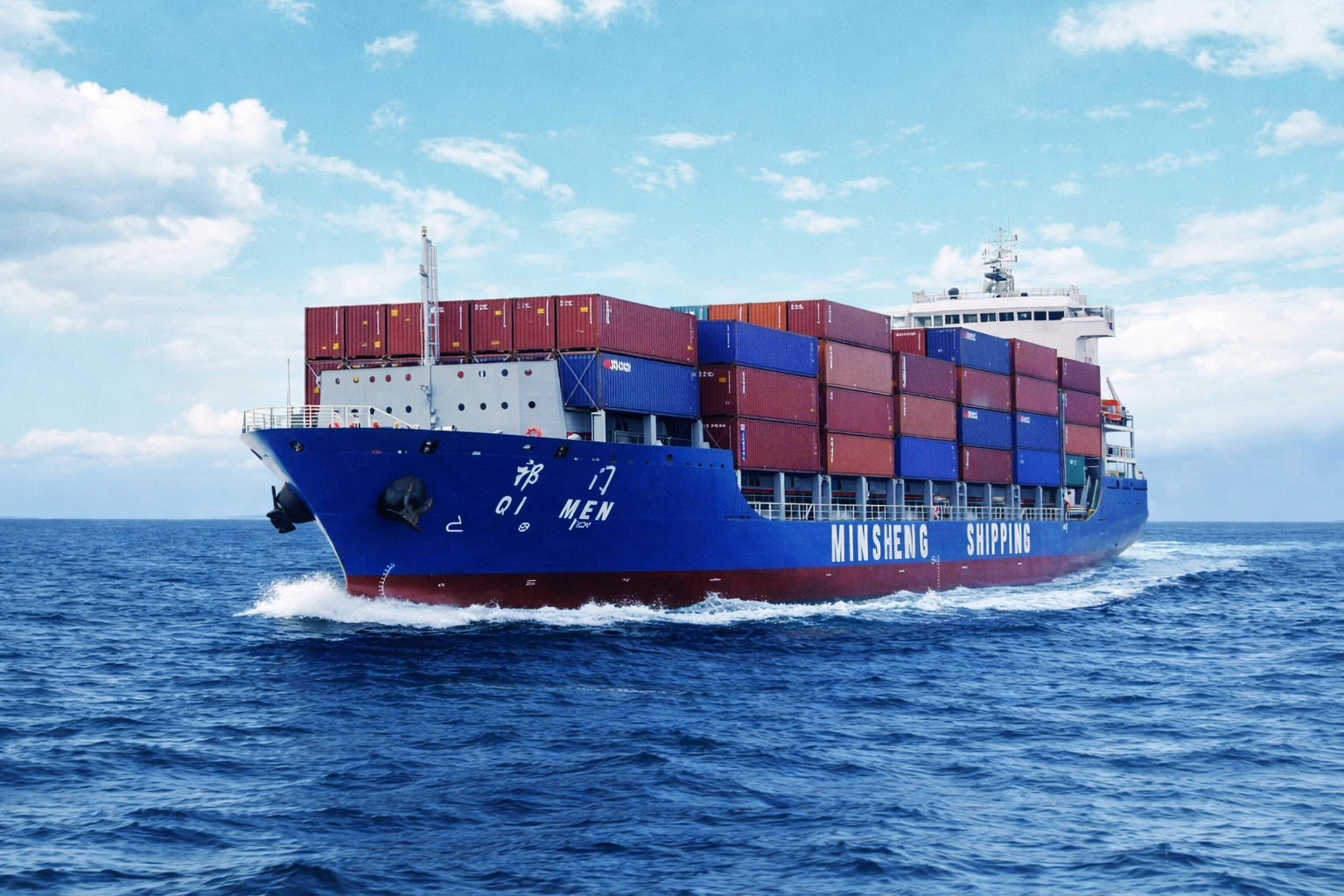
In the current environment of elevated ocean freight rates and carrier capacity volatility, having a freight forwarder with proprietary direct routes is no longer a nice-to-have — it is a supply chain imperative. Mingsung's CT1 and CT2 direct services to Shanghai represent a decades-long investment in route infrastructure that pays dividends for every shipment.
The CT1 and CT2 Route Architecture
Mingsung operates two direct Taiwan–China service strings:
- CT1 — North/Central Taiwan to East China: Covers Keelung, Taipei, and Taichung with direct calls to Shanghai and Ningbo. Frequency: 2–3 weekly sailings. Transit time: 24–36 hours port-to-port. This route serves Taiwan's technology corridor, moving electronics, machinery, and semi-finished goods between the island's northern manufacturing cluster and China's largest port complex.
- CT2 — South Taiwan to East China: Kaohsiung direct to Shanghai and Ningbo. Frequency: 2 weekly sailings. Transit time: 36–48 hours. CT2 serves the southern industrial belt — petrochemicals, plastics, steel, and consumer goods — connecting Kaohsiung's deep-water port directly to the Yangtze Delta manufacturing hubs.
Why Direct Matters: The Transshipment Cost Hidden in Standard Rates
Many ocean freight quotes include a transshipment at Hong Kong, Pusan, or Singapore without explicitly itemizing this cost. Each transshipment hub adds 2–5 days of transit time, 1–2 days of port handling, and risk of cargo damage or loss during container restuffing. More critically, at transshipment hubs your cargo competes with all other cargo for onward vessel space — during peak season or congestion events, your "booked" shipment can be rolled to the next sailing without notice.
Mingsung's direct services eliminate all three hidden costs: no transshipment delay, no additional handling, and no rolling risk. For Taiwan exporters shipping to Shanghai or the Yangtze Delta — which collectively represent over 40% of Taiwan's total ocean freight volume — a direct service is simply a better product at equivalent or lower total cost.
Japan Seto Inland Sea: Mingsung's Exclusive Market
Beyond Taiwan–China, Mingsung operates three Japan services covering the Seto Inland Sea — a region most major carriers serve only indirectly:
- CJ1: China–Hiroshima Express (Fukuyama, Mizushima, Hiroshima) — weekly direct service to Japan's western industrial corridor
- CJ2: Shikoku/Chugoku Region Line — covering smaller ports across Ehime and Okayama prefectures
- CJ3: North China to Japan Line — connecting Tianjin and Qingdao to Japan's Seto Inland Sea ports
For Taiwanese companies exporting to Japanese industrial buyers in the Hiroshima–Osaka corridor, Mingsung's CJ services eliminate the standard 3–5 day delay of connecting via Osaka or Yokohama. The result: shorter inventory cycles for Japanese buyers, stronger competitive positioning for Taiwan suppliers, and a freight cost that benchmarks well against major carrier indirect services.
The FCL vs. LCL decision is one of the most frequently asked questions in export logistics — and also one of the most misunderstood. Many shippers default to LCL because it "feels" cheaper, or to FCL because it "feels" safer. The reality is more nuanced, and getting it right can mean the difference between 20% cost savings and an unnecessary premium.
The Core Tradeoff: Cost vs. Control
FCL (Full Container Load) means you rent an entire container — typically a 20-foot (TEU, approx. 25–28 CBM) or 40-foot (FEU, approx. 55–58 CBM) box — exclusively for your cargo. You pay for the whole container regardless of how full it is. LCL (Less-than-Container Load) means your cargo shares container space with other shippers' goods; you pay only for the cubic meters or weight your cargo occupies, plus a handling fee for consolidation and deconsolidation.
The Break-Even Point: When FCL Becomes Cheaper Than LCL
- Under 5 CBM: LCL is almost always more economical. A 20ft container at current Taiwan–Southeast Asia rates costs roughly the equivalent of 18–22 CBM of LCL freight — so filling a full box at these volumes is wasteful.
- 5–15 CBM: This is the contested zone. FCL can be economical if you can source a consolidation partner to fill the container, or if your cargo is fragile/high-value and the reduced handling of FCL justifies a small premium.
- Over 15 CBM: FCL is almost always the right choice. At 15+ CBM, the per-CBM cost of FCL typically matches or beats LCL rates, and you gain faster transit (no wait for CFS consolidation) and lower handling risk.
When to Choose FCL Regardless of Volume
Volume thresholds are not the only factor. Choose FCL whenever: (1) your cargo is fragile or high-value and cannot tolerate multiple handling events during LCL consolidation; (2) your shipment contains Dangerous Goods — most DG cargo cannot be consolidated with non-DG cargo in LCL; (3) you have strict transit time requirements — FCL vessels typically offer faster and more predictable port-to-port schedules; (4) temperature control is required — reefer FCL is the only viable option for temperature-sensitive cargo.
Mingsung's FCL/LCL Optimization Service
For clients with regular ocean freight volumes, Mingsung offers a quarterly freight optimization review — analyzing your shipment history, route mix, and consolidation opportunities. We have helped multiple Taiwan exporters reduce their ocean freight spend by 15–25% simply by shifting the FCL/LCL boundary at the right volume threshold and leveraging Mingsung's direct routes to eliminate transshipment premiums. Contact our ocean freight team to schedule your optimization review.
The Yangtze River Economic Belt — spanning Chongqing, Wuhan, Nanjing, and the broader Yangtze Delta — is one of Asia's most dynamic manufacturing corridors. Yet for cross-border logistics, it has historically been underserved: inland rail and road transport to coastal ports add time, cost, and handling complexity. Mingsung's River-Sea Intermodal service fundamentally changes this equation.
The "One-Vessel" Concept
Mingsung's River-Sea Intermodal model operates on a simple but powerful principle: cargo loaded in Chongqing, Wuhan, or Nanjing stays in the same container as it travels down the Yangtze River to Shanghai, then transfers to a coastal or international feeder vessel for onward routing to Taiwan or global ports. This "one-vessel" (一船到底) approach minimizes handling, reduces damage risk, and dramatically compresses total transit time compared to multi-modal alternatives that involve truck or rail to the coast, followed by terminal transfer and transshipment.
The Time and Cost Advantage: Real Numbers
- Chongqing to Taiwan (via river-sea intermodal): 4–6 days total. Via highway to Shenzhen plus ocean: 7–9 days. Via railway to Tianjin plus ocean: 8–12 days. Savings: 3–8 days.
- Cost vs. air freight: River-sea intermodal costs approximately 15–20% of equivalent air freight rates for comparable cargo — an 80% cost saving. For manufacturers in the Yangtze Belt shipping to Taiwan or Japan, this is the optimal balance of speed and cost.
- Cost vs. pure ocean (road to coastal port): Eliminating the inland truck segment from Chongqing to Chengdu-Qingdao or Guangzhou — often the most expensive leg — reduces total freight cost by 20–35%.
Mingsung's Yangtze Belt Network
Mingsung operates river barge services connecting: Chongqing → Wuhan → Nanjing → Shanghai, with scheduled weekly departures from each river port. At Shanghai, cargo transfers to Mingsung's CT1/CT2 coastal services for direct routing to Taiwan, or to major carrier connections for Europe, North America, and Southeast Asia. For Chongqing manufacturers — Mingsung's original home city since 1925 — this service represents a century of continuous route expertise and carrier relationships that no newer entrant can match.
✅ Client Impact
A Chongqing-based automotive parts manufacturer shifted 60% of their Taiwan-bound shipments from road-to-port to Mingsung's river-sea intermodal service. Result: average transit time reduced from 9 days to 5 days, freight cost per shipment reduced by 28%, and cargo damage incidents fell to zero due to the single-handling model. Annual savings exceeded NTD 4.2 million.