|
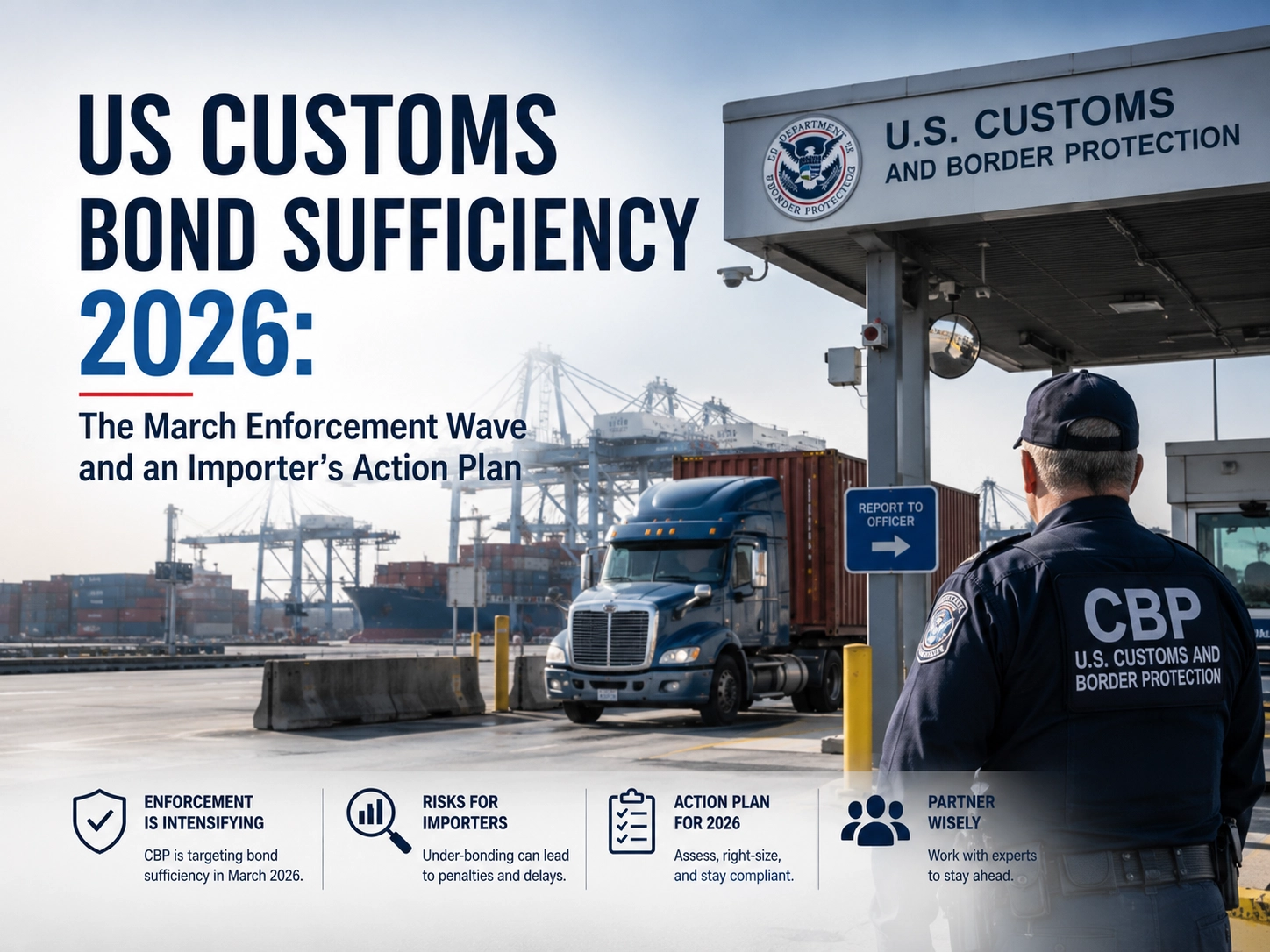
• US Customs Compliance · May 2026 US Customs Bond Sufficiency 2026: The March Enforcement Wave and an Importer's Action Plan.CBP launched sweeping bond enforcement in March 2026, plus intensified 5H inspections. Insufficient bonds now trigger entry refusal. Here's the 2026 importer action plan. EST 2026-05-11 · READ 8 min · CBP · BOND · ACE |
|
— TL;DR / The Quick Read Section 122 + 232 + 301 stacking pushed effective duty rates 3× higher for many importers. A $50K continuous bond sized in 2024 may now trigger ACE insufficiency at the $150K+ requirement. Once flagged, you get 30 days — not negotiable. Shared forwarder bonds no longer fly. Liquidated damages can equal full merchandise value, or 3× for restricted goods. |
|
10% CBP bond sufficiency rule |
30 days Insufficiency notice cliff |
3× Bond requirement increase (typical) |
$450K Max LD exposure per 40' container |
— 01 / WHAT CHANGED
What Changed in March 2026.
In March 2026, US Customs and Border Protection (CBP) launched sweeping enforcement targeting non-compliant import bonds, shared bonds, and improper customs clearance practices. Combined with intensified 5H inspections, many freight forwarders and cross-border sellers face detentions, rejections, or even loss of clearance privileges.
For US importers, the message is direct: your continuous bond must be properly sized, properly named, and properly maintained — or your shipments stop moving.
CBP requires your continuous bond to be at least 10% of your total duties, taxes, and fees from the prior 12 months. ACE compares 10% of your trailing 12-month duty total to your current bond amount — if the calculated requirement exceeds your bond face value, ACE flags it as insufficient.
|
— 02 / THREE STACKING FORCES Why Bonds Suddenly Look Undersized in 2026.Three forces are pushing duty totals (and therefore bond requirements) sharply higher:
|
— 03 / 30-DAY CLIFF & THE SHARED-BOND TRAP
When ACE Flags Your Bond — 30 Days to Cure.
When ACE flags your bond, CBP issues written notice to the importer (and surety) requiring increased bond. You have 30 days to either rider the existing bond to a higher amount or replace with a larger one. Miss the deadline and CBP can:
| 01Refuse entry of subsequent shipments |
| 02Place the bond on manual review list (entry delays) |
| 03Terminate the bond entirely |
The 30-day window is not negotiable. Importers who discover the notice after Day 25 are in damage-control mode.
| The Shared-Bond Trap: A common 2024-2025 practice — small importers used a forwarder's continuous bond instead of obtaining their own. In March 2026, CBP explicitly targeted this practice. The new rule: bonds must be tied to your actual company name & EIN (Importer of Record). Using a forwarder's bond for multiple shippers is now high-risk and often invalid. |
• Quick Answer Q2 / Q3: Can I use my forwarder's bond? What if I miss the 30-day notice? Generally no — CBP's March 2026 enforcement specifically targets shared-bond practices; bonds should be tied to your EIN as Importer of Record. Miss the 30-day insufficiency notice and CBP can refuse subsequent entry, place the bond on manual review, or terminate entirely. |
|
— 04 / PENALTY MATH Liquidated Damages & Reasonable Care.If you breach bond obligations, liquidated damages can equal the full value of the merchandise involved in the default — or 3× the value for restricted/prohibited goods.
Beyond bond sufficiency, CBP's "reasonable care" doctrine demands importers actively manage classification, valuation, and documentation. Reasonable care failures compound bond penalties. Key signals CBP examines:
|
— 05 / 30-DAY ACTION PLAN
The Importer's 30-Day Action Plan.
| Days | Action |
|---|---|
| 1–3 | Calculate 12-month trailing duty + projected next 12 months under 2026 rates |
| 4–7 | Compare against current bond face value; identify shortfall |
| 8–14 | If shortfall, contact surety for rider or replacement bond quote |
| 15–21 | Submit increased bond before any ACE flag appears |
| 22–30 | Audit reasonable-care documentation; refresh classification SOP |
• Quick Answer Q1: How often should I review bond sufficiency? Quarterly minimum; monthly if your import volume or tariff exposure is increasing. |
|
— 06 / MINGSUNG AUDIT Mingsung's Bond & Compliance Audit.Mingsung's standard import client audit covers:
|
|
— READY TO SHIP? Let's find your supply chain
|