
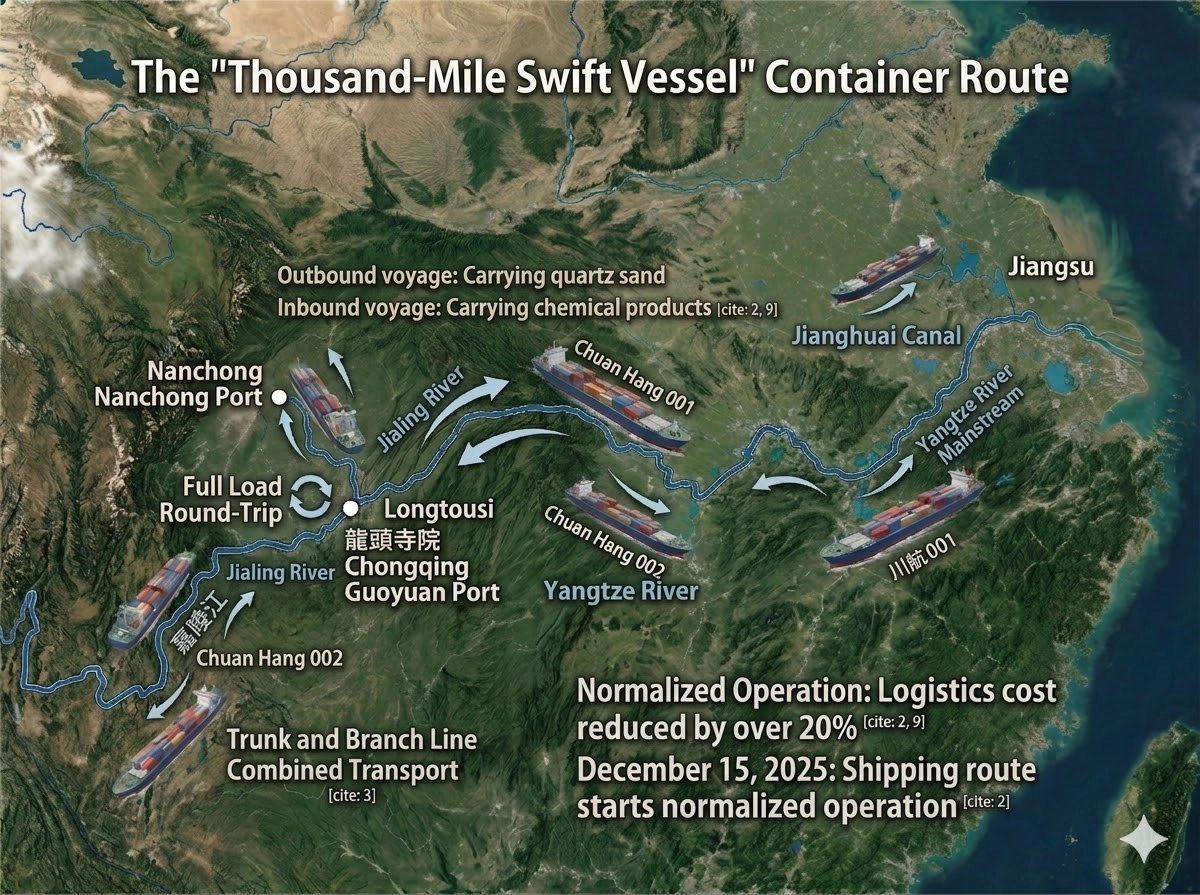
On December 15, 2025, the cargo vessels "Chuan Hang 001" and "Chuan Hang 002" set sail from Chongqing’s Guoyuan Port, each laden with 20 TEUs of quartz sand. Their successful arrival at Nanchong’s Dujing Port on the 19th officially marks the transition of Minsheng Shipping’s "Jiangsu–Guoyuan–Nanchong" (Qianli Qingzhou) container route into regular, scheduled operations. This is more than just a route opening; it represents a major breakthrough in the "trunk-to-branch" intermodal transport model for Southwest China.
Trunk-to-Branch Intermodal Transport: Unlocking the Jialing River’s "Golden Waterway"
Historically, container transport on the Jialing River faced several critical pain points, including navigational channel restrictions, inconsistent lock throughput efficiency, and the logistical challenge of empty container repositioning. Minsheng Group has successfully dismantled these bottlenecks through the following four strategic optimizations:
1. Schedule Optimization: Precision timing for lock transits and voyage synchronization.
(This ensures that ships aren't idling at the locks—which is the quickest way to kill a profit margin.)
2. Intelligent Dispatch: Strategic empty container repositioning to eliminate "deadheading" and resource waste.
(In the industry, "deadheading" or "empty running" is our greatest enemy. This strategy ensures every mile traveled is a mile paid for.)
3. Port Synergy: Deep integration with Nanchong Port to streamline stevedoring and intermodal handovers.
(Efficiency on the water is useless if you're stuck at the pier. This is about making sure the "handshake" between the ship and the shore is seamless.)
4. Operational Stability: Ensuring consistent, reliable, and "always-on" route performance.
(A shipping route is only as good as its reputation. This is about moving from "trial runs" to a service that shippers can set their watches by.)
5. Loaded-Both-Ways: Achieving dual-track optimization of vessel utilization and operating costs.
(This is the ultimate goal—full containers going out, full containers coming back. It’s the secret sauce behind that 20% cost reduction you mentioned.)
Following nearly four months of trial operations, the "Qianli Qingzhou" route has successfully established a "loaded-both-ways" virtuous cycle:
- Outbound Leg: Transporting industrial raw materials, such as quartz sand.
- Inbound Leg: Carrying chemical products back to the Yangtze River corridor, significantly boosting vessel utilization rates.
Performance Data: In the first three quarters of 2025, the route reached a cumulative container throughput exceeding 100 TEUs. Preliminary estimates indicate that once the route is fully normalized and stabilized, it will help shippers reduce comprehensive logistics costs by more than 20%.
Future Outlook: Empowering the Regional Economy through Cost-Efficiency Optimization
Looking ahead to 2026, Minsheng Group will continue to scale and refine the "Qianli Qingzhou" model. Beyond increasing sailing frequency and operational stability, the group aims to diversify the cargo base suitable for waterway transit while collaborating with ports along the route to enhance the collection and distribution infrastructure. These initiatives will continue to drive "cost-efficiency optimization" for regional logistics, injecting fresh economic momentum into the Jialing River basin.
💡 FAQ
Q1: What exactly is the "Qianli Qingzhou" Trunk-to-Feeder Intermodal Service?
Answer: This refers to a strategically integrated logistics model that connects the Yangtze River (the Trunk line) with the Jialing River (the Feeder line). By utilizing Guoyuan Port as a primary transshipment hub, the service ensures the seamless and efficient transfer of bulk and containerized commodities between major waterways and regional branches.
Q2: What is the projected cost-saving for shippers using this route?
Answer: Based on recent operational data, the transition to regularized, scheduled service is expected to reduce comprehensive logistics costs for shippers by more than 20%. These savings are achieved through improved scheduling, reduced idle times, and optimized equipment usage.
Q3: What types of cargo are typically handled on the return leg?
Answer: The return leg (backhaul) currently focuses on transporting chemical products destined for industrial centers along the Yangtze River corridor. This achieves a "loaded-both-ways" (full-in, full-out) cycle, which maximizes vessel utilization and ensures the highest level of cost-efficiency for the entire voyage.